HORMONES 2007, 6(1):80-82
Address for correspondence:
Prof. Demetrios A. Spandidos, 10 Vriaxidos Str, Athens 116 35, Greece, Phone: + 30 210 7517117, Fax: +30 210 7252922, e-mail: spandidos@spandidos.gr
Received 12-06-06, Revised 20-11-06, Accepted 10-12-06
Abstract
This article attempts to analyze the crucial link between the plant Agnus castus and human health, particularly hormonal status, with special reference to the needs of the society of ancient Sparta. T he ancient Spartans used Agnus both as a cure for infertility and as a remedy to treat battle wounds. T hese special properties were recognized by the sanctuary of Asclepios Agnita, which was located in S parta, as well as by medical practitioners in S parta during the classical, Hellenistic and Roman ages.
Key words: Ancient Sparta, Asclepius, Agnus castus, Hormonal modulator
THE GROWTH OF MEDICINE IN ANCIENT SPARTA
One of the most critical problems that classi-cal Sparta faced was oligandria, the decline in the number of Spartan male citizens who had civil rights and were capable of fighting for Sparta. Recurrent wars, either conquering or defensive, unremitting and gruelling military drilling, battle wounds and numerous war fatalities caused the population of Sparta’s common male citizens-this did not include the population of helots and perioikoi-to chronically be in decline. One means of confronting this problem was through worship of the gods.
Goddesses of fertility such as Helen, Orthia Artemis, Artemis Cyparissia and Artemis Eilithia (pro-tector of childbirth) were worshipped in the city of Sparta from the Homeric years. At the same time, however, efforts for development of scientific medicine were also persued.1-7
Sources report that during the Hellenistic years Sparta maintained close bonds with the Ptolemy dynasty of Alexandria, a city that comprised the most important medical centre of that era.1 This relationship resulted in the development of Sparta into an important centre of teaching and practice of medicine, this being confirmed by historical data and inscriptions. For example, an inscription of the 2nd century BC, discovered on the island of Kythera, attests to the existence of a citizen studying medicine in Laconia.2
Pliny the Elder recounts that in 219 BC the Spartan doctor Archagathos was working as a surgeon in Rome.3 According to certain sources, this doctor was the first Greek physician in Rome, the Romans possessing no medical tradition before him.4 In the 3rd and 2nd centuries BC two famous “public doctors”, known by the title of Archiatroi, operated in Sparta, acquiring social recognition by offering medical services.5
Apart from the aforementioned we should not omit allusion to Agathinos, “a man of validity” as Galen states. He was born in Sparta and practised and taught medicine in Rome from 60 to 100 AD. He founded the Eclectic or Episynthetic School of medi-cine and was the tutor of important doctors such as ArhigenesandLeonidas.Accordingtomanyscholars Galen’s medical practice and his deep knowledge of previous methods and testimonies classified him as one of the followers of the eclectic faculty.6
SANCTUARY OF ASCLEPIOS AGNITA
In 160 AD, in his description of Sparta, the geographer and historian Pausanias cites the existence of three Asclepios Sanctuaries. It is of particular significance that in one of those, the Sanctuary of Asclepios Agnita, the statue of one of the gods was made of Agnus castus wood (Figure1), from which the sanctuary took its name.
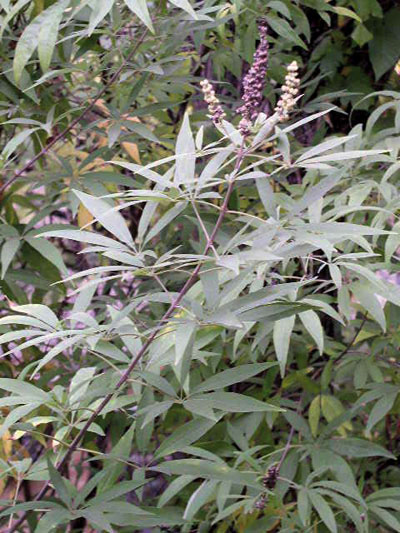
Figure 1. The plant Agnus castus.
Pausanias saw the sanctuary in 160 AD, at a time when Sparta enjoyed particular prosperity. The fact that the statue of the god was made of Agnus castus when other materials, for example marble, existed in abundance, demonstrates the great importance attached to the medical attributes of the plant. Also worthy of mention is the statue of Artemis at the sanctuary of Orthia Artemis “erect Artemis”. The appellation was interchangeable with the name Ly-godesma, as legend claims that the statue was found in a “lygo” or wicker bush (Agnus) which wrapped “desma” its branches around the statue and “held the statue upright”. The symbolism of the fable is explicit: The standing man (?ρθιος) is the healthy man. Therefore, the myth shows that the agnus cas-tus medical attributes were not unknown in ancient Sparta.
MEDICAL ATTRIBUTES OF AGNUS CASTUS
By looking back in time and examining medicine in the light of historical research, we realise that the effects of Agnus castus and the regulatory abilities that it has on the human body were valued in antiq-uity. In fact, Agnus was used for many ailments of the human body. Hippocrates, Theophrastos and mainly Dioscourides mentioned the plant as an anaphrodi-siac, Dioscourides also proposing baths with Agnus for the treatment of diseases of the uterus, a use that did not differ much from later perceptions. Through-out history the plant has generally been associated with sexual desire. For instance, throughout the duration of the Thesmophorion, Athenian women placed Agnus leaves under their bed in order to remain agnes (pure).
The ancient Greeks also used Agnus as a heal-ing means for their wounds as well as for snake and animal bites. In England, monks of the Catholic Church put Agnus seeds in their pockets to aid them inkeepingtheiroathsofchastity.Thisiswhytheseed of the plant was known as “monk pepper”.
Even though the name Agnus derives from the Greek agnos meaning “pure”, thus tending to emphasize the repressive effects of Agnus castus on human sexual desire, scientific research has today demonstrated that the seeds and the fruit of Agnus castus possess a number of medical applications in addition to the anaphrodisiac uses, such as aphrodisiac, galactogogue, ophthalmic, sedative and stomachic.
More generally speaking, it has been used to treat female hormonal disorders and is considered to be a hormonal modulator.8 The property of Agnus as a repressor of erotic desire, an anaphrodisiac, was probably of least concern to the Spartan society.
Agnus berries have a range of medicinal properties, but possibly the most important one is its ability to rectify hormonal imbalances caused by an excess of oestrogen and an insufficiency of progesterone. It acts upon the pituitary gland, reducing the production of certain hormones and increasing the production of others, shifting the balance in favour of the gestagens. It thus has a wide application of uses in malfunctions of the feminine reproductive system and has been used with effectiveness in restoring absent menstruation,9 regulating heavy periods, modulating Prolactin,10 restoring fertility when this is caused by hormonal imbalance,11 relieving pre-menstrual tension and easing the transition to menopause.12 Agnus castus essential oil also exerts antibacterial activity.13
In fact, the seeds of Agnus castus have ostensibly contradictory effects, since they reportedly stimulate and ‘smoothe’ the function of the pituitary gland, thus creating a balancing effect in the production of hormones,andespeciallyprogesterone.Thisexplains why Agnus is considered both an aphrodisiac and an anaphrodisiac, since it increases sexual activity in those who are not very sexually active while simultaneously decreasing it in those who are very active.
CONCLUSIONS
Today it is debatable whether such types of treatment are entirely acceptable. It is also unclear whether the Spartans, and more specifically Spartan doctors, knew of the therapeutic attributes of Agnus castus. However, whether or not they were fully ac-quaintedwiththosepropertiessohighlysignificantto them-namely, the effect it exerts upon the woman’s hormonal system in the re-establishment of absent menstruation, in the regulation of heavy periods and, most particularly, in the re-establishment of fertility, the birth of healthy children being of vital concern to the Spartan society-the Asclepiads (physicians) of Asclepios Agnita sanctuary certainly applied en-docrinological procedures by utilising the plant in practical treatments of infertility.
REFERENCES
1. Longrigg J, 1981 Superlative achievement and comparative neglect. Alexandrian medical science and modern historical research. History of Science 19: 155-200.
2. Forrest WG 1972 A metrical inscription in Coldstream, Kythera, Excavations and studies JN Huxley, G.L. London; pp, 1-314.
3. Jackson R, 1988 Doctors and Diseases in the Roman Empire. British Museum Press.
4. Kurt Pollak 1969 Die Heilkunde der antike Griechenland-Rom-Byzanz. Die Medizin in Bibel und Talmud, Econ Verlag GmbH, Dusseldorf und Wien.
5. Nutton V 1977 Archiatri and the medical profession in antiquity. Papers of the British School at Rome 45; pp, 191-226.
6. Tsoulogiannis IN, Spandidos DA 2005. In: Asclepius Sanctuaries in Laconia. Athens; pp, 1-75.
7. Pausanias’ description of Greece, Laconica 16: 7-11.
8. British Herbal Pharmacopoeia 1996, Vitex Agnus Castus (monograph). British Herbal Medicinal Association Bournemouth, Dorset, England.
9. Probst V, Roth OA, 1954 A plant extract with hormonic effects. Dtsch Med Wochenschr 79: 1271-1274.
10. Brown D 1994 Vitex agnus castus. Clinical Monograph. Herbal Research Review: Quarterly Review of Natural Medicine.
11. Christie S, Walker AF, 1997-1998 Vitex agnus castus L: A Review of Its Traditional and Modern Therapeutic use. Eur J Herbal Med 3: 29-45.
12. Wutke W, Jarry H, Cristoffel V, Spengler B, Seidlova-Wuttke D, 2003 Chaste tree (Vitex agnus-castus)—phar-macology and clinical indications. Phytomedicine 10: 348-357.
13. Kustrak D, Kuftinec J, BlazevicN,1992Thecomposition of essential oil of Vitex agnus castus. Planta Medica 52: Suppl 1: 681.