HORMONES 2015, 14(3): 438–441
DOI: 10.14310/horm.2002.1560
Athanasios Fountas,1 Stelios Tigas,1 Zoe Giotaki,1 Dimitrios Petrakis,2 George Pentheroudakis,2 Agathocles Tsatsoulis1
1Department of Endocrinology, University of Ioannina, Greece
2Department of Medical Oncology, University of Ioannina, Greece
Address for correspondence:
Stelios Tigas, Department of Endocrinology, University of Ioannina, 45110, Ioannina, Greece, E-mail: stigas@cc.uoi.gr
Received: 28-08-2014, Accepted: 12-09-2014
Abstract
OBJECTIVE: Sunitinib is a tyrosine kinase inhibitor used in the therapy of pancreatic neuroendocrine tumors (PNETs), metastatic renal cancer and gastrointestinal stromal tumors. We describe a patient with PNET who presented with severe hypoglycemia following sunitinib administration.
CASE REPORT: A 64-year old man with known metastatic PNET presented with a history of recurring episodes of severe, life-threatening hypoglycemia 3 months after initiation of sunitinib treatment. Investigations during symptomatic hypoglycemia revealed inappropriately increased plasma insulin and C-peptide levels, consistent with endogenous hyperinsulinemia. No immune staining for insulin was observed in tissue samples from peritoneal metastatic tumor lesions, and serum anti-insulin antibodies were negative. Medical management with diazoxide, methylprednisolone and ocreotide was ineffective; continuous intravenous infusion of glucagon was required to maintain euglycemia. Following discontinuation of sunitinib there was gradual improvement in both the severity and frequency of the hypoglycemia. Six months later, the patient remained free of hypoglycemic episodes.
CONCLUSIONS: We describe a patient with PNET who experienced severe, life-threatening hypoglycemia following sunitinib use. It is important that glucose levels of patients treated with sunitinib are monitored on a regular basis; those patients with diabetes may need to have their antidiabetic treatment adjusted to prevent hypoglycemia.
Key words: Hypoglycemia, Insulin, Pancreatic neuroendocrine tumor, Sunitinib
INTRODUCTION
Pancreatic neuroendocrine tumors (PNETs) are rare, with an incidence of less than 1 case per 100,000 population per year, while they represent 1-2% of all pancreatic tumors.1 These neoplasms may be sporadic or inherited, as in certain familial syndromes such as multiple endocrine neoplasia type 1, Von Hippel-Lindau disease and neurofibromatosis type 1.
Sunitinib is a tyrosine kinase inhibitor (TKI) that has been shown to have tumor-stabilizing effects and to increase progression-free survival when used in the therapy of patients with PNETs.2,3 Recent reports suggest that sunitinib may affect glucose metabolism in both diabetic and non-diabetic individuals.4,5
We describe a patient with a non-secretory, metastatic PNET who presented with recurring episodes of severe, symptomatic hypoglycemia 3 months following initiation of sunitinib treatment.
CASE REPORT
A 64-year old man was referred to the Endocrine Department with a 3-month history of recurring episodes of severe, life-threatening hypoglycemia in both the fasting and the postprandial state. The patient initially presented in the summer of 2011 with atypical abdominal pains; CT imaging at the time revealed a 5×6 cm pancreatic mass, as well as multiple hepatic and lymph node metastases (Figure 1). An ultrasound-guided liver biopsy was suggestive of a non-secretory PNET (positive for CD56, keratin-19 and synaptophysin, Ki67: 1-2%). The patient’s past medical history included essential hypertension (adequately controlled on a combination of amlodipine 10 mg od, atenolol 25 mg od and hydroxychlorthiazide 6.25 mg od) and renal stones. There was no family history of malignancy of hyperparathyroidism.
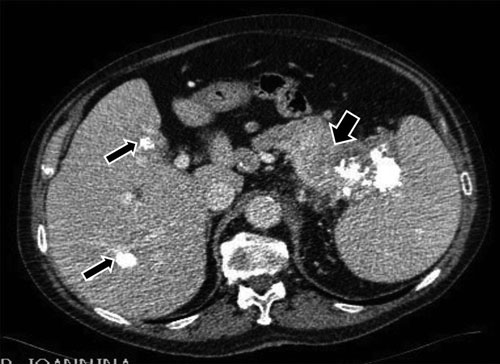
Figure 1. Mass infiltrating the tail of the pancreas (thick arrow) and hepatic metastases (thin arrows).
In November 2011, on the basis of a scintigram (octreoscan) positive for the presence of somatostatin receptors, the patient was started on everolimus 10 mg od and octreotide LAR 20 mg monthly. Twelve months later, the octreotide LAR dose was increased to 30 mg monthly and the patient remained on this combination for a total of 22 months.
In September 2013, routine imaging studies revealed disease progression (as evidenced by an increase in the size and number of infiltrated lymph nodes and the presence of metastatic lesions in the lungs). Consequently, the patient’s antineoplastic therapy was modified: the everolimus was discontinued and sunitinib was started at a dose of 37.5 mg od, whilst the somatostatin analogue was continued at the same dose.
Three months following the initiation of sunitinib, the patient developed episodes of hypoglycemia that were initially corrected by ingestion of food. However, the severity and frequency of these episodes increased progressively and in February 2014 the patient was admitted to hospital following an episode of loss of consciousness due to severe hypoglycemia (plasma glucose: 36 mg/dl), requiring intravenous dextrose administration.
The patient was at that stage referred to the Endocrine Department for investigation and further management. Clinical examination revealed hepatomegaly and mild tenderness on palpation over the epigastrium. Blood pressure was 120/75 mm Hg, pulse rate 86/min regular, body mass index 25.4 (height 174 cm, body weight 77 kg).
Laboratory investigations did not reveal any evidence of hypothyroidism, nor liver or adrenal insufficiency [TSH 0,46 μIU/ml (0.34-5.6), FT4 1.03 ng/dl (0.6-1.37), INR 1.1 (0.8-1.2), albumin 4.5 g/dl (3.4-5), cortisol 18.4 μg/dl (6.7-22.6)] and the patient was not on any other medication known to cause hypoglycemia. Additional testing included a supervised prolonged fast; after 8 hours of fasting the patient developed symptomatic hypoglycemia (plasma glucose 21 mg/dl) with inappropriately increased pl sma insulin and C-peptide levels [insulin 34 μIU/ml (<3), C-Pept 6.2 ng/ml, (<0.6)]. During hypoglycemia, glucagon testing was performed; following administration of 1 mg of glucagon intravenously (iv), plasma glucose rose from 21 mg/dl to 73 and 100 mg/dl at 15 and 30min, respectively, indicating that glycogen restores were adequate, consistent with a hyperinsulinemic state.6 Serum anti-insulin antibodies were negative. Sunitinib treatment was at that stage discontinued.
In order to control the patient’s recurring hypoglycemic events, he was started on diazoxide 100 mg tds, gradually increasing the dose to 200 mg tds, and he was put on a diet with frequent meals of low glycemic index foods. However, neither these measures nor the addition of octreotide 200 mg tds sc and methylprednisone 16 mg bd proved effective. Continuous iv glucagon infusion at a rate of 0.1 mg/h was eventually required to maintain euglycemia.
An attempt to reduce tumor burden by surgical debulking proved unsuccessful because of the presence of extensive and widespread metastases in the abdominal cavity, rendering any further surgical intervention both futile and risky.
In the weeks following discontinuation of sunitinib, there was gradual improvement in both the severity and frequency of the hypoglycemic episodes and the diazoxide and methylprednisolone doses were gradually reduced and eventually stopped one month later. The patient was at that stage started on chemotherapy, using a combination of streptozocin/adriamycin. Six months later, the patient’s condition was stable and he remained free of hypoglycemic episodes.
DISCUSSION
Sunitinib is a multi-targeted TKI that has shown activity against a range of signaling pathways and growth factors/receptors, including vascular endothelial growth factor receptors (VEGFR) 1, 2 and 3 as well as platelet-derived growth factor receptors (PDGFR) alpha and beta, stem cell factor receptor KIT, glial cell-line derived neurotrophic factor (REarranged during Transfection; RET), FMS-like tyrosine kinase-3 (FLT3) and colony-stimulating factor receptor (CSF-1R).7-9 It has been used in the management of metastatic renal cancer, of advanced PNET and of stromal gastrointestinal tumors, and in the management of iodine-refractory differentiated thyroid cancer and metastatic medullary carcinoma of the thyroid.10,11
Interestingly, sunitinib use has been associated with improvements of glycemic control in diabetic patients.12,13 Moreover, sunitinib has resulted in reversal of type 1 diabetes in experimental animals,14 and there are two recent reports of patients with established type 1 diabetes who were able to discontinue insulin for several months, whilst being on sunitinib treatment for a PNET and for renal cell carcinoma, respectively.15,16
The exact mechanism through which sunitinib lowers plasma glucose levels is currently unclear. Several potential explanations have been proposed, mainly based on the effects of imatinib, another TKI, on carbohydrate metabolism. Imatinib treatment has been observed to ameliorate diabetes mellitus in both experimental animals and humans,17,18 most likely via a protective, antiapoptotic effect on β-cells mediated by nuclear factor-κB. Billemont et alhave suggested the possibility of sunitinib having an impact on insulin resistance by interfering with the IGF-1 pathway.12 Similarly, Hagerkvist et al. observed that imatinib decreased insulin resistance and hepatic glucose production in a rat model.19 The platelet-derived growth factor signaling pathway, through which sunitinib works, was recently shown to control age-dependent β-cell proliferation in mouse and human pancreatic islets.20
The episodes of spontaneous hypoglycemia in our patient’s case were due to endogenous hyperinsulinemia, which could in theory be due to either insulin production by tumor cells or to stimulation of endogenous insulin secretion in otherwise healthy pancreatic islets. In order to explore the possibility of sunitinib-induced transformation of the nonfunctioning PNET cells into insulin producing cells, as was previously described,21 a tissue biopsy was obtained from a peritoneal metastatic lesion. However, immune-staining was negative for insulin but positive for CD56, synaptophysin and chromogranin. In addition, the fact that following discontinuation of sunitinib the hypoglycemic episodes gradually improved and eventually disappeared would suggest a transient mechanism stimulating insulin secretion, rendering the possibility of tumor transformation unlikely.
To our knowledge, this is the first report of a patient experiencing sunitinib-induced, life-threatening hypoglycemia, resistant to all modes of treatment but intravenous glucagon administration. Unlike what we observed in our patient, in another report of a patient with sunitinib-induced spontaneous hypoglycemia, the authors registered a response with prednisolone treatment given at a dose of just 2.5 mg daily.22
From a clinical perspective, it is important that glucose levels of patients treated with sunitinib are monitored on a regular basis. In particular, patients with type 1 or type 2 diabetes who are treated with sunitinib may need to have their antidiabetic treatment adjusted to prevent hypoglycemia.
REFERENCES
1. Wild S, Roglic G, Green A, Sicree R, King H, 2004 Global prevalence of diabetes: estimates for the year 2000 and projections for 2030. Diabetes Care 27: 1047-1053.
2. Canaris GJ, Manowitz NR, Mayor G, Ridgway EC, 2000 The Colorado thyroid disease prevalence study. Arch Intern Med 160: 526-534.
3. Perros P, McCrimmon RJ, Shaw G, Frier BM, 1995 Frequency of thyroid dysfunction in diabetic patients: value of annual screening. Diabet Med 12: 622-627.
4. Wu P, 2007 Thyroid disorders and diabetes. It is common for a person to be affected by both thyroid disease and diabetes. Diabetes Self Manag 24: 80-82, 85-87.
5. Chubb SA, Davis WA, Inman Z, Davis TM, 2005 Prevalence and progression of subclinical hypothyroidism in women with type 2 diabetes: the Fremantle Diabetes Study. Clin Endocrinol (Oxf) 62: 480-486.
6. Nathan DM, Buse JB, Davidson MB, et al, American Diabetes Association; European Association for the Study of Diabetes; 2009 Medical management of hyperglycemia in type 2 diabetes: a consensus algorithm for the initiation and adjustment of therapy: a consensus statement of the American Diabetes Association and the European Association for the Study of Diabetes. Diabetes Care 32: 193-203.
7. Velazquez EM, Mendoza S, Hamer T, Sosa F, Glueck CJ, 1994 Metformin therapy in polycystic ovary syndrome reduces hyperinsulinemia, insulin resistance, hyperandrogenemia, and systolic blood pressure, while facilitating normal menses and pregnancy. Metabolism 43: 647-654.
8. Dunaif A, 2008 Drug insight: insulin-sensitizing drugs in the treatment of polycystic ovary syndrome-a reappraisal. Nat Clin Pract Endocrinol Metab 4: 272-283.
9. Vigersky RA, Filmore-Nassar A, Glass AR, 2006 Thyrotropin suppression by metformin. J Clin Endocrinol Metab 91: 225-227.
10. Isidro ML, Penín MA, Nemiña R, Cordido F, 2007 Metformin reduces thyrotropin levels in obese, diabetic women with primary hypothyroidism on thyroxine replacement therapy. Endocrine 32: 79-82.
11. Cappelli C, Rotondi M, Pirola I, et al, 2009 TSH-lowering effect of metformin in type 2 diabetic patients: differences between euthyroid, untreated hypothyroid, and euthyroid on L-T4 therapy patients. Diabetes Care 32: 1589-1590.
12. Cappelli C, Rotondi M, Pirola I, et al, 2012 Thyreotropin levels in diabetic patients on metformin treatment. Eur J Endocrinol 167: 261-265.
13. Díez JJ, Iglesias P, 2013 Relationship between serum thyrotropin concentrations and metformin therapy in euthyroid patients with type 2 diabetes. Clin Endocrinol (Oxf) 78: 505-511.
14. Morteza Taghavi S, Rokni H, Fatemi S, 2011 Metformin decreases thyrotropin in overweight women with polycystic ovarian syndrome and hypothyroidism. Diab Vasc Dis Res 8: 47-48.
15. Rotondi M, Cappelli C, Magri F, et al, 2011 Thyroidal effect of metformin treatment in patients with polycystic ovary syndrome. Clin Endocrinol (Oxf) 75: 378-381.
16. Alevizaki M, 2013 Metformin and the thyroid: some questions still remain. Clin Endocrinol (Oxf) 78: 503-504.
17. Santos-Palacios S, Brugos-Larumbe A, Guillén-Grima F, Galofré JC, 2013 A cross-sectional study of the association between circulating TSH level and lipid profile in a large Spanish population. Clin Endocrinol (Oxf) 79: 874-881.
18. Rezzónico J, Rezzónico M, Pusiol E, Pitoia F, Niepomniszcze H, 2011 Metformin treatment for small benign thyroid nodules in patients with insulin resistance. Metab Syndr Relat Disord 9: 69-75.
19. Oleandri SE, Maccario M, Rossetto R, et al, 1999 Three-month treatment with metformin or dexfenfluramine does not modify the effects of diet on anthropometric and endocrine-metabolic parameters in abdominal obesity. J Endocrinol Invest 22: 134-140.
20. Lupoli R, Di Minno A, Tortora A, Ambrosino P, Arianna Lupoli G, Di Minno MN, 2014 Effects of Treatment With Metformin on TSH Levels: A Meta-analysis of Literature Studies. J Clin Endocrinol Metab 99: E143-148.
21. Krysiak R, Okopien B, 2011 Thyrotropin-lowering effect of metformin in a patient with resistance to thyroid hormone. Clin Endocrinol (Oxf) 75: 404-406.
22. Bogachus LD, Turcotte LP, 2010 Genetic downregulation of AMPK-alpha isoforms uncovers the mechanism by which metformin decreases FA uptake and oxidation in skeletal muscle cells. Am J Physiol Cell Physiol 299: 1549-1561.
23. Duntas LH, Orgiazzi J, Brabant G, 2011 The interface between thyroid and diabetes mellitus. Clin Endocrinol (Oxf) 75: 1-9.
24. Fox CS, Pencina MJ, D’Agostino RB, et al, 2008 Relations of thyroid function to body weight: cross-sectional and longitudinal observations in a community-based sample. Arch Intern Med 168: 587-592.