HORMONES 2003, 2(3):186-188
DOI: 10.14310/horm.2002.11100
Address correspondence and requests for reprints to:
Professor of Medicine, Athens University School of Medicine, 12, Stratiotikou Syndesmou Str., 106 73 Athens, e-mail: daik@otenet.gr
Received 01-06-03, Revised 15-06-03, Accepted 30-06-03
The Hippocratic medical school (the medical school of Kos) was not an isolated phenomenon but the evolution and consequence of previous ideas and practices derived from many older sources. Hippocratic medicine1-3 replaced the theurgical and hieratic medicine, succeeding to and evolving from the medicine of the Minoan civilization of Crete, the Homeric poems and the pre-Hippocratic Greek philosophers: the Milesians, the Pythagoreans and the Sicilians. Before the Hippocratic School was formed, the medical schools of Cyrene, Croton, Rhodes, Elaia and Knidos already existed.
The Hippocratic Corpus
A great debate is still going on among scholars (Littré being the first) about the books that constitute the so-called Hippocratic Corpus. An effort is being made to classify them a) as genuine works of the great Teacher, b) as written by Hippocrates’ disciples, c) as later works etc. The truth is that these books represent a continuum, expressing the teachings of the Hippocratic School of Kos. Hippocrates’ son-in-law, Polyvos, is considered by some to have played a role similar to that of Plato for Socrates.
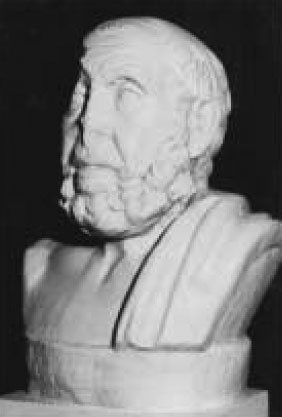
Figure 1. Replica of a copy of the most authentic bust of Hippocrates found in the tomb of a Graeco-Roman physician near Ostia (1940).
The Hippocratic Spirit1-3
It is hard to summarise what the main characteristics of the Hippocratic spirit were. We can, however, emphasise some of the main points. a) Study and description of disease with scientific exactitude, detailed history, careful physical examination, inspection, palpation and auscultation. b) Epidemiological history complete with weather information and the local conditions prevailing at the time of the epidemic. c) Efforts to elucidate the pathophysiology of disease as far as the prevailing beliefs of the time allowed, but also beyond those. d) The importance of the patient and his illness and not the disease (nosos) itself. e) Emphasis on prevention and healthy habits. The physician should be an instructor of the public for hygienic life. Thus, the Hippocratic books contain the first introduction to the importance of lifestyle. f) Emphasis on the significance of diet (there are 4 books on Diet). g) Contrary to the School of Knidos, the whole, in contrast to the part, is emphasised. h) Humane medicine and compassion for the suffering man.
We will try to delineate the Hippocratic spirit by some characteristic examples
Methodology
In the following passage from Ancient Medicine, the requirements for investigating new areas and the optimism characteristic of the Greeks of the Golden Age are truly admirable: “Full discovery will be made, if the inquirer is competent and conducts his research with the knowledge of the discoveries already made and makes them his starting point”. (Ancient Medicine, 21).
Help, or at least to do no harm (Ωφελεειν η μη βλαπτειν)
“The Art consists of three factors: the disease,the patient,the physician. The physician is the servant of the Art; the patient must cooperate with the physician in combatting the disease”. (Epidemics 1st, 11). Some people say that Medicine in those days was paternalistic. The last sentence speaks to the contrary.
Life Style
“Even now some people, the barbarians and some Greeks, who have no knowledge of medicine, go on behaving when they are ill, just as they do in health. They neither abstain from nor moderate the use of the things they like”. (On Ancient Medicine, 5).
What is Man
“There are some physicians and sophists who maintain that no one can undestand the science of medicine unless he knows what man is. Anyone who proposes to treat men for their illnesses must first learn that”. “I do not believe that any clear knowledge of Nature can be obtained from any source other than a study of medicine and then only through a thorough mastery of this science”. (On Ancient Medicine, 20).
Master Description of Disease
Parotitis: “Many people suffered from swellings near the ears, in some cases on one side only, in others both sides were involved. Usually there was no fever and the patient was not confined to bed. Many
patients had dry, unproductive coughs and hoarse voices. In some patients soon after the onset of the disease, but sometimes after an interval, one or both testicles became inflamed and painful. Some had fever, some not. These cases were serious enough to warrant attention, but for the rest, there were no illnesses requiring care. (Epidemics 1st, 1).
Exercise -Rest
“Diseases caused by over-eating are cured by fasting. Those caused by starvation are cured by feeding-up. Diseases caused by exertion are cured by rest. Those caused by indolence are cured by exertion”. (Nature of Man, 9).
In the book On Diet 3 (Regimen III), there is a detailed program for exercises according to the season and in relation to the food. (Diets 3, Regimen III), 140, (14-150).
Medicine and Physicians practicing it. Quality Control
“Although the art of healing is the most noble of all the arts, because of the ignorance both of those practicing it and of their rash critics, it has at this time fallen into the least repute of them all”. “The chief cause for this seems to me to be that it is the only science for which states (poleis) have laid down no penalties for malpractice. Physicians are many in name, few in fact”. (On Ancient Medicine, 9).
Medical errors
“Exactness is difficult to achieve and small errors are bound to occur.
I warmly commend the physician who makes the least errors.
Infallibility is rarely to be seen. Most physicians seem to me to be in the position of poor navigators.In calm weather they can conceal their mistakes, but when overtaken by a mighty storm or a violent gale, it is evident to all that it is their ignorance and error which ruin the ship”.
Prerequisites for studying Medicine
“For a man to be truly suited to the practice of medicine, he must be possessed of a natural disposition for it, the necessary instruction, favorable circumstances, education, industry and time. The first requisite is a natural disposition, for a reluctant student renders every effort vain”. (Hippokrates Law, or Canon).
Evidence based Medicine
” But conclusions which are merely verbal cannot bear fruit, only those do which are based on demonstrated facts (evidence, endeixis). For affirmaton and talk are deceptive and treacherous.Wherefore one must hold fast to facts ….if one is to acquire that ready and infallible habit, which we call medicine (iatriki)”. (Precepts 7).
Medical Fees
“I urge you not to be unkind, but consider carefully your patient’s means.
Sometimes offer your services for nothing, calling to mind a previous benefaction or present satisfaction. And if there be an oppportunity of serving one who is a stranger in financial straits, give full assistance to all such , for where there is love of man, there is also love of the Art”. (Parangeliai 6, Precepts VI).
The Hippocratic Oath
The so called Hippocratic Oath is actually older than Hippocrates though how much older is impossible to ascertain, the Hippocratic School having received and perfected it. It is remarkable that in a text of not more than a page,acode of medical ethics is presented that has survived so many centuries, being accepted and valid to our days. Later the first Christian physicians did not want to recite the oath swearing by the heathen gods, but gradually they omitted the heading and kept the text,or changed it to swear by the Holy Trinity.
“I will use my power to help the sick to the best of my ability and judgement. I will abstain from harming or wronging any man by it”.
In this phrase the ethics of the practice of the medical profession are concentrated. The physician pledges to use all his means, knowledge, and abilities to help the sick, to the best of his judgement. It is implied that he should keep abreast of the current knowledge and that he will decide to the best of his judgement.
This has served as the basis of the medical authority and responsibility.
“I will not give a deadly (thanassimon) drug (pharmakon) to anyone, if I am asked, nor will I suggest any such a thing. Neither will I give a woman means to procure an abortion”.
It is surprising that such a statement is made against euthanasia and abortion, thereby showing respect for the beginning and the end of life.
The confidentiality protecting the patient’s privacy which is so much stressed in the oath has today become problematic with the type of medicine that is increasingly applied worldwide. There is nowadays a deviation from Hippocratic ethical codes with emphasis on the confidentiality in the doctor-patient relationship, the data bases being accessible to non-medical authorities.
Humane Medicine
As an extension of the principles of the Oath, there are passages in the Corpus describing humane medicine as being one of the main components of the Hippocratic heritage. We encounter concepts that were propounded later throughout the Christian era. The great Greek fathers of the Church have called such concepts the “thyrathen paedeia”, or the spermatic logos.
Human medicine
“For the physician (iatros) sees terrible sights, touches unpleasant things, and the misfortunes of others bring a harvest of sorrows that are peculiarly his (επ’ αλλοτριησι ξυμφορησιν ιδιας καρπουται λυπας)”.
“But the sick by means of the art rid themselves of the worst of evils, disease, suffering, pain and death for Medicine proves for all these evils a manifest cure”. (Physai 1, Breaths 1).
The humane spirit is one of our great Hippocratic heritages.
REFERENCES
1. Hippocrates 1923-1995 Loeb Classical Library, Harvard University Press; vol I-VIII.
2. Hippocratic Writings 1983 Penguin Classics, (ed) G.E.R Loyd, London.
3. Marketos SG 1997 The medical school of Kos, Hippocratic Medicine, Human Sciences, Forum, Trends in Experimental and Classical Medicine; vol 7, pp, 313-324.